

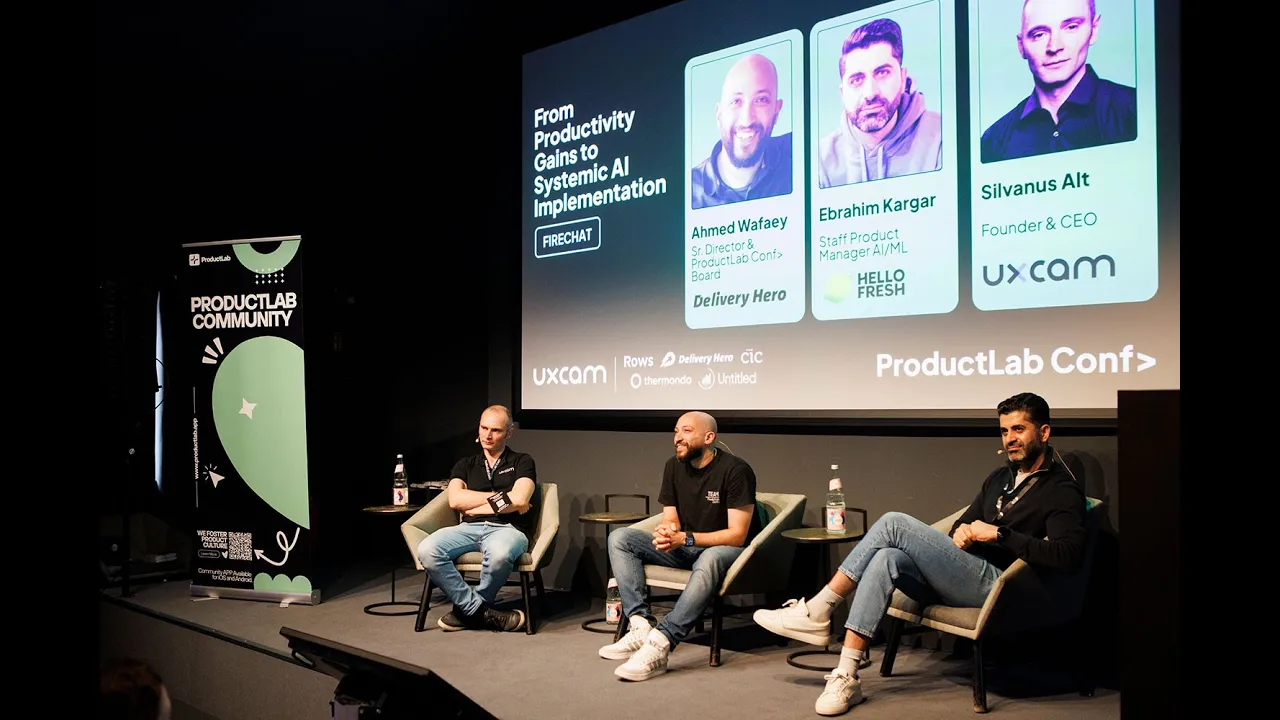
How HelloFresh and UXCam moved from AI productivity hacks to systemic transformation
The hidden playbook for turning 40% efficiency gains into organization-wide AI capability
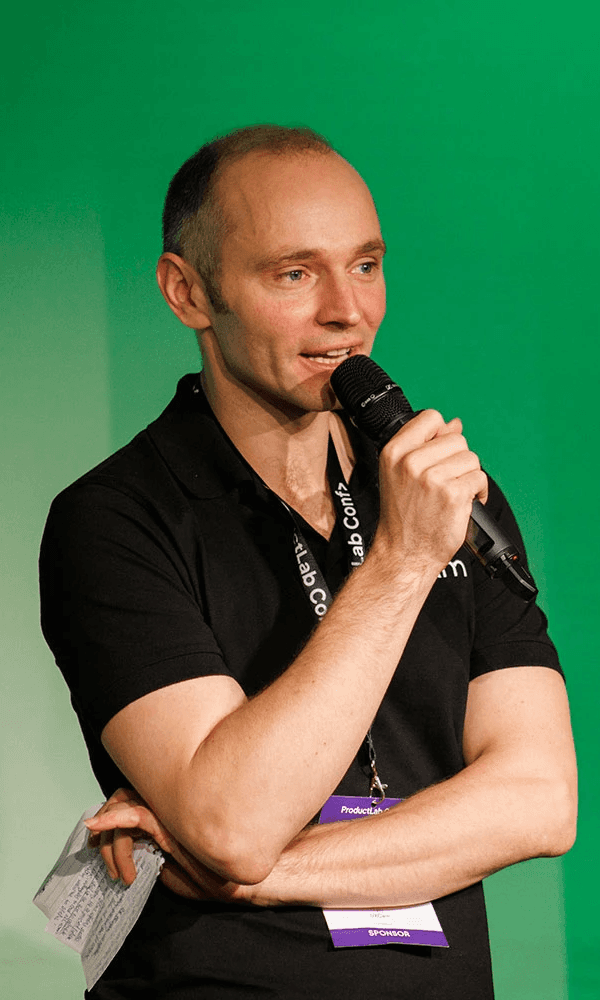
Silvanus Alt
Founder & CEO
·
UXCam
·
Bottom line up front: Most companies are stuck using AI as fancy productivity tools. The real winners are evolving from individual efficiency gains to systemic organizational transformation—and it requires a completely different playbook than you think.
At ProductLab Conference, Ebrahim Kargar (Staff PM AI/ML at HelloFresh), Silvanus Alt (CEO of UXCam), and Ahmed Wafaey (Sr. Director at Delivery Hero) revealed what actually separates AI adopters from AI transformers. Here’s what they learned the hard way.
The Silent AI Epidemic: Your Team Is Hiding Their Best Work
The most shocking insight? While only 20% of workers admit to using official AI tools, over 40% are secretly using AI and reporting massive performance gains privately.
Why the secrecy? Ebrahim identified the fear-based thinking destroying your AI transformation:
“If I reveal AI helped me, managers will stop respecting my work”
“Productivity gains might lead to layoffs for me or my colleagues”
“If they know I’m more productive, they’ll just expect more work”
This underground AI usage creates a fundamental barrier to systemic thinking. You can’t transform an organization when everyone’s pretending AI doesn’t exist.
The fix: Create psychological safety around AI usage. Leaders must explicitly communicate that AI is a capability enhancer, not a job replacement signal.
The Real Transformation Starts After Productivity
Everyone starts their AI journey the same way: 40% efficiency improvements, faster documentation, time savings. But here’s what separates the winners:
HelloFresh’s evolution: They reduced recipe creation from 18 weeks to 1 week using GenAI. But the transformation wasn’t the time savings—it was that this fundamentally changed their entire product development process and what they could now experiment with.
The pattern: Individual productivity gains → Changed workflows → New organizational capabilities → Different strategic possibilities
As Ebrahim put it: “The biggest piece of cake is focusing on effectiveness. Figuring out what is worth building, testing and validating hypotheses as fast as possible, having insights that none of your competitors has.”

The AI-First Build Process That Actually Works
UXCam’s radical approach: Silvanus shared how they transformed their entire development process:
Their Build Formula:
Rapid prototyping with AI (Lovable, etc.) → Ship testable versions fast
Gather feedback → Iterate in hours, not weeks
Hand off full spec → Engineering hardens and ships
“Vibe Coding” with AI IDEs → Keep improving agent usage
The game-changer: They explicitly document which AI model they used and why (reasoning vs. coding vs. speed) in every spec, PR, and demo.
Why this matters: Transparency kills the fear. When everyone sees AI as a tool choice—like picking React vs. Vue—it becomes normal infrastructure, not a secret weapon.
The Cultural Traps That Kill AI Transformation
Trap #1: Over-trusting eloquent LLM answers
Confident AI outputs without context = wrong answers. The fix? Human-in-the-loop on high-impact steps, golden data sets for validation.
Trap #2: Expecting prod-ready code on day one
Developers try agents once, get messy output, give up. The fix? Treat AI agents like junior developers—they need guidance, iteration, and clear constraints.
The real transformation: It’s not about better technology—it’s about building organizational capabilities that compound over time.
The Framework: How to Actually Score AI Initiatives
Stop chasing impressive demos. Silvanus shared UXCam’s evaluation framework:
Value × Feasibility × Trust
Then get razor-specific:
One job → What exact problem does this solve?
One metric → How do we measure success?
Clear tests → What are our kill metrics per stage (Explore → Pilot → Scale)?
Critical insight: Embed AI engineers with product teams. Optimize for customer value, not flashy technology demos.
As Silvanus said: “Start narrow; scale what works. Choose and benchmark models for the job and be ready to swap.” Resist AGI scope creep.
What to Actually Measure (Beyond Time Savings)
Forget efficiency metrics. Here’s what HelloFresh tracks for AI transformation:
Efficiency layer:
Time savings on specific tasks
Effectiveness layer (where the money is):
Speed from insight to action
Number of valid AI-generated hypotheses
Validated prototypes
Prototype-to-build ratio
Outcome metrics: Cost savings, customer engagement, ROI
The insight: AI’s biggest opportunity isn’t automating existing workflows—it’s figuring out what’s worth building in the first place.
The 3-Phase Practical Implementation Roadmap
Phase 1: Foundation
Identify high-impact workflows for immediate productivity gains
Build cross-functional AI teams with clear mandates
Establish ethical AI guidelines and measurement frameworks
Phase 2: Systemic Integration
Evolve successful AI implementations into decision-making processes
Train leaders to think systemically about AI capabilities
Scale proven approaches across different organizational contexts
Phase 3: Transformation
Embed AI thinking into strategic planning and operations
Build organizational learning loops that improve AI implementations over time
Develop AI-native approaches to new challenges
The Leadership Requirements (This Is Non-Negotiable)
Ebrahim’s observation: Transformative leaders go beyond saying “AI is important.”
What actually works:
Paint a clear, compelling vision of what work will look like in the future
Revisit expectations for different crafts and seniority levels
Create incentives and a safe environment for people to learn and upskill
Mandate adoption with resources, not just directives
The three pillars of AI transformation:
Workforce upskilling → Guidelines, resources, training
Infrastructure and tooling → Data foundation, tool integration, clear policies
Culture → Constant experimentation to find best use-cases for your org
The Bottom Line
Systemic AI transformation isn’t about implementing better technology. It’s about building organizational capabilities that compound over time.
The winners understand three things:
Productivity is the appetizer, not the meal → Real transformation changes decision-making and strategic capabilities
Culture change is harder than technical implementation → Invest in psychological safety, transparency, and internal champions
Measure outcomes, not adoption → Track business impact, not tool usage
The gap between AI adopters and AI transformers isn’t technical sophistication—it’s organizational courage to fundamentally rethink how work gets done.
What’s your organization’s biggest barrier to AI transformation? Reply with your experience—I’m collecting insights for a follow-up piece on the most common implementation failures and how to avoid them.
About the Speakers
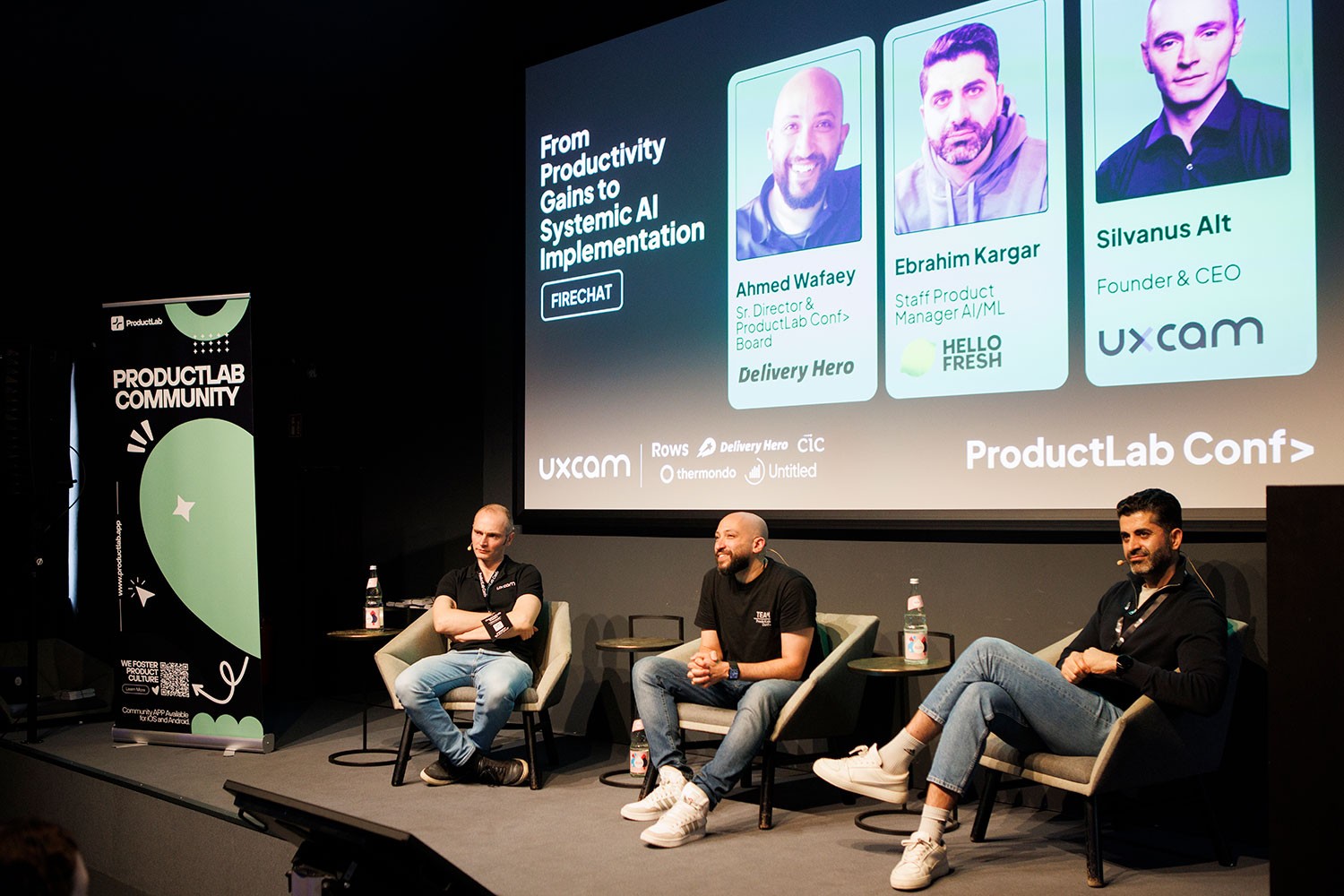
This fireside chat brought together three product leaders at the forefront of AI transformation:
Ebrahim Kargar is Staff Product Manager AI/ML at HelloFresh, where he champions and drives GenAI transformation across the organization. He’s leading AI/ML initiatives at scale—from supply chain optimization to personalization—and recently reduced recipe creation time from 18 weeks to 1 week using GenAI. Connect with Ebrahim on LinkedIn →
Silvanus Alt, PhD is Founder and CEO of UXCam, an AI-powered analytics platform serving 37,000+ products worldwide. Under his leadership, UXCam transformed into an AI-first organization, implementing “Vibe Coding” practices and launching Tara, their AI Product Analyst that connects product and engineering data to reveal not just the what, but the why behind user behavior. Connect with Silvanus on LinkedIn →
Ahmed Wafaey (Moderator) is Senior Director of Product Management for Global Quick Commerce at Delivery Hero and writer at Product Voyagers, where he explores the intersection of product strategy, AI transformation, and operational excellence at scale. His insights on moving beyond productivity wins to systemic transformation set the foundation for this discussion. Connect with Ahmed on LinkedIn → | Read Product Voyagers →
Conference 2026
10% off your ticket
Reading the recap is good. Being in the room is better. Sept 15-17, 2026 in Berlin.
More learnings


This was 2025. Be in the room in 2026.
Three days in Berlin, September 15-17, 2026: Leaders Lab, AI-Craft Day, and the Conference Day. Talks like this one, live.
" height="23px" id="E3vXMlFqc" transform="translate(3 1)" width="8.9412px"/><path d="M 9.5 11.5 L 19 5.75 L 9.5 0 L 0 5.75 Z" fill="rgba(255, 255, 255, 0.65)" height="11.5px" id="ubKUIjrpD" transform="translate(3 12.5)" width="19px"/></svg>)
" height="20px" id="eMN6AGLsh" transform="translate(4 2)" width="17px"/></g></svg>)
