

Why 97% of companies fail at product transformation
The brutal truth about going from project to product—and the 4-part framework that actually works
Chris Compston
Product Ops Consultant
·
Consultant
·
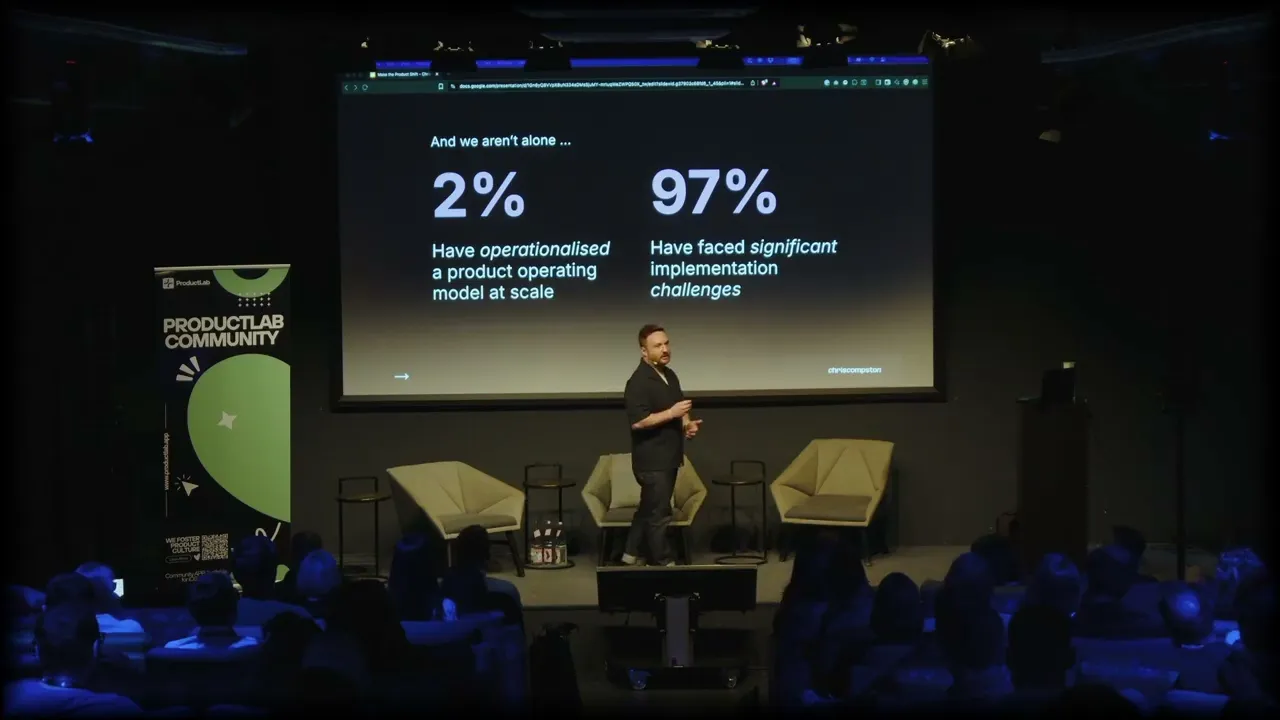
Here’s what nobody tells you about product transformation: 97% of organizations trying to shift from project to product-thinking face significant implementation challenges.
Even worse? Only 2% have actually operationalized product operating models at scale.
I just watched Chris Compston (founder and consultant who helps organizations build great product operating models) break down exactly why this shift is so hard—and more importantly, how actually to make it work.
If your organization is stuck shipping features instead of creating outcomes, this is for you.
The shift everyone talks about (but few achieve)
Let’s be honest. We all know the theory:
Stop saying: “We shipped new features and met our deadline”
Start saying: “Our customers can now achieve something new”
Stop saying: “We never have data, so we’re guessing”
Start saying: “We’re making evidence-based decisions”
Stop saying: “Sales told us to build this”
Start saying: “We know what customers value”
Sounds simple, right? So why does almost everyone fail?
The three reasons transformation is brutally hard
1. No actionable guidance Everyone encourages product thinking (books, conferences, podcasts, ChatGPT). But there’s a massive gap between “be more outcome-focused” and actually doing it within your organization’s unique context.
2. The economy is punishing Tech layoffs. Global instability. The AI revolution. You’re being asked to do way more with way less—fewer people, smaller budgets, zero room for “safe to fail” experiments.
3. Organizations are built for certainty Most companies operate on the manufacturing model: “We’ll deliver X things and make Y money.” They’re built for certainty, which makes them reactive rather than responsive to change. In these companies increasing efficiency is often the only lever they can pull to differentiate them from their competitors.
The stat that should scare you
Customer-focused organizations are 60% more profitable.
And here’s the kicker: 50% of organizations say that in 5 years, 80% of their work will use product thinking.
That means your competitors are making this shift right now. The question isn’t whether to change—it’s whether you’ll be in the 2% who actually succeed.
The framework that changes everything
Chris developed his approach after some significant learnings from his time introducing change Farfetch (a luxury fashion platform where a transformation affecting 1,000 people took 3-4x longer than predicted).
Here’s what he learned:
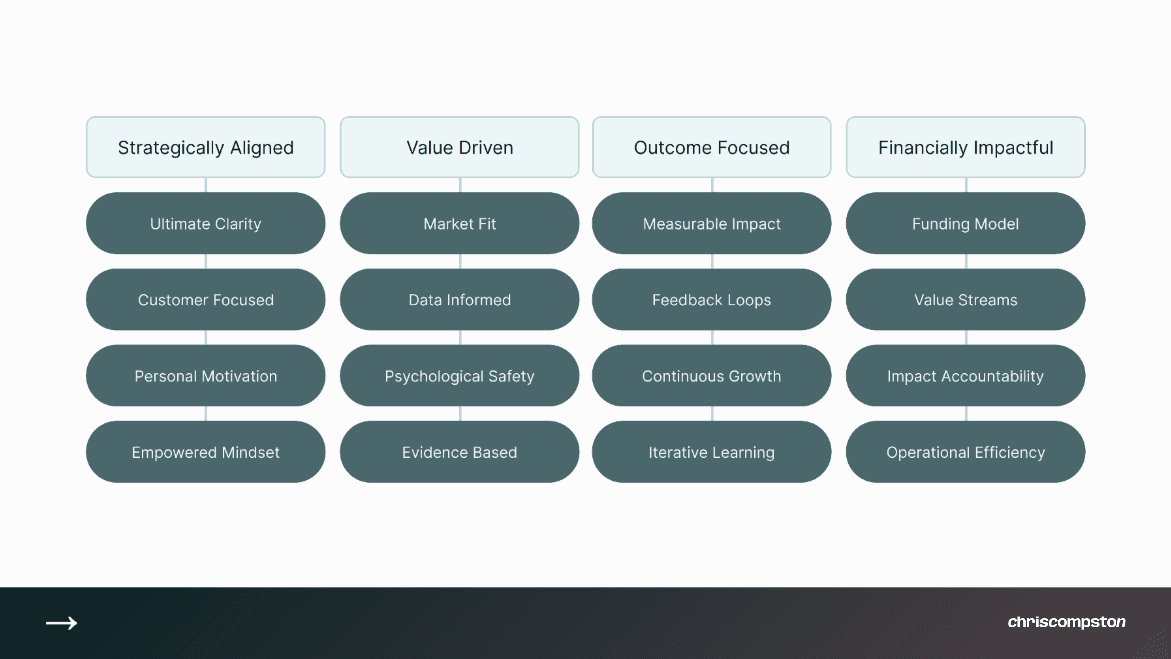
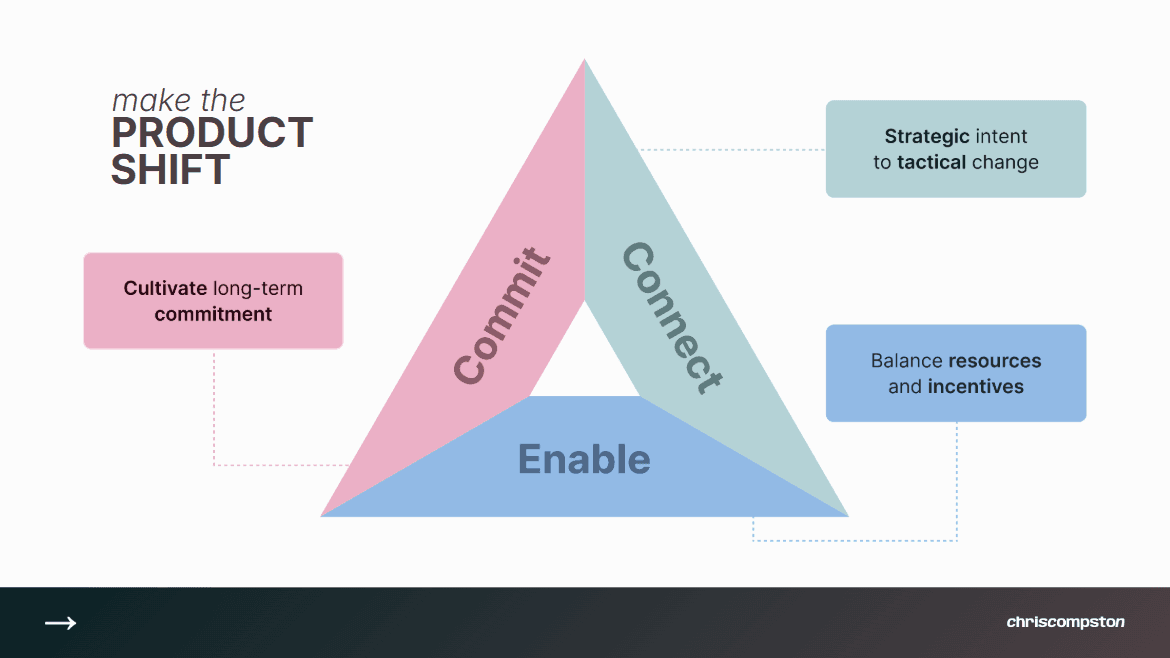
Part 1: Connect strategic intent to tactical change
Don’t just say “let’s make more money” and “let’s be outcome-focused.”
Instead: Identify specific organizational capabilities you need to build—things like:
Iterative learning
Evidence-based decision making
Customer discovery
Cross-functional collaboration
Connect the high-level vision to concrete behavioral changes.
Part 2: Balance resources and incentives
You need BOTH:
Readiness: Do people have the right skills, tools, time, and space?
Motivation: What’s in it for them?
Salary increases or role changes
Learning budgets
Recognition (internal and external)
Growth opportunities
Most transformations focus only on readiness and wonder why nothing sticks.
Part 3: Cultivate long-term commitment
Don’t do this:
Top-down directives (”Go be outcome-focused!”)
Narrow team focus (”Fix iterative learning in your squad”)
Vague mandates (”We’re a product company now—figure it out”)
Do this instead:
Create cross-functional working groups that:
Pull from different roles (product, design, data, engineering, finance, marketing)
Include different seniority levels
Work across multiple teams
Focus on one organizational capability at a time (e.g., “improve iterative learning across the entire org”)
This is how you get broad organizational impact instead of isolated team improvements.
Extra: Show, don’t tell (or ask)
When you’re stuck with external delivery commitments but trying to shift to product thinking:
Don’t: Ask permission to experiment Do: Find capabilities you can shift quietly, prove the value, then show the results
Experiment in safer spaces where you can demonstrate impact without high-stakes visibility.
The real-world challenge (and solution)
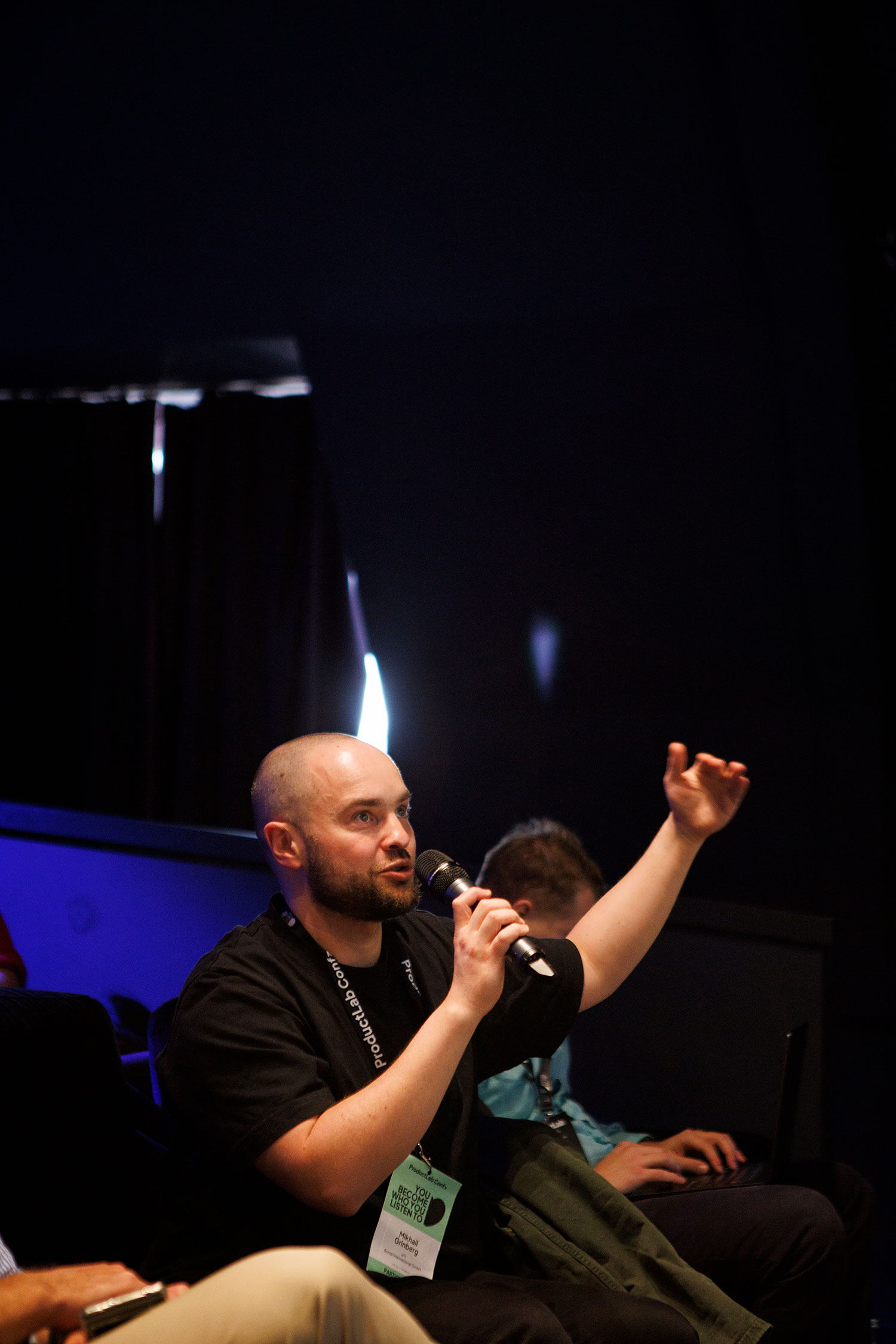
Someone in the audience asked the perfect question: “We have external commitments through next year. How do we shift to product thinking when we’re locked into deliverables?”
Chris’s answer was brilliant:
Your CPO (or top product leader) should be putting in the hard work to convince the exec team that outcome-focused work drives MORE business impact. They’re the ones who own the budget and the funding model.
As a PM on a team, it’s not your responsibility to make this happen; however, you can support this shift. By starting small, experimenting with more outcome-focused work, changing how you produce discovery, or ensuring iterative learning is taking place.
You can’t always predict how much revenue is going to be generated in a year’s time. You can, however, be more confident with that estimation if you’re using a funding model that allows you to build products and learn on a more regular basis.
What to do right now
Audit your organizational capabilities: Which ones need work? Where are the gaps between your strategic vision and tactical reality?
Balance readiness and motivation: Don’t just focus on skills and tools. What’s actually motivating people to change?
Start small and cross-functional: Pick ONE capability. Create a working group across teams and functions. Make visible progress.
Show value before scaling: Find safe spaces to experiment. Prove the model works. Then expand.
The bottom line
The product shift isn’t optional if you want to lead. Customer-focused organizations are 60% more profitable. Your competitors are already moving.
But transformation isn’t about reading the right books or attending the right conferences. It’s about connecting strategic intent to tactical change, balancing resources with incentives, and cultivating genuine commitment across your organization.
Most importantly: It’s about being in the 2% who actually make it work.
P.S. Chris is writing a book on this framework with co-authors Esra Yetis and Hugo Froes. You can learn more at maketheproductshift.com or connect with Chris on Substack: or LinkedIn.
Conference 2026
10% off your ticket
Reading the recap is good. Being in the room is better. Sept 15-17, 2026 in Berlin.
More learnings


This was 2025. Be in the room in 2026.
Three days in Berlin, September 15-17, 2026: Leaders Lab, AI-Craft Day, and the Conference Day. Talks like this one, live.
" height="23px" id="E3vXMlFqc" transform="translate(3 1)" width="8.9412px"/><path d="M 9.5 11.5 L 19 5.75 L 9.5 0 L 0 5.75 Z" fill="rgba(255, 255, 255, 0.65)" height="11.5px" id="ubKUIjrpD" transform="translate(3 12.5)" width="19px"/></svg>)
" height="20px" id="eMN6AGLsh" transform="translate(4 2)" width="17px"/></g></svg>)
