

Productlab Conf
Blog
One page per year. 2026: what the conference meant, every talk with its video and slides. 2025: every talk, written up.
For Claude, ChatGPT or Gemini
Ask your AI
Everything about Productlab in one file: the talks, learnings and transcripts from 2026 and 2025. Copy it into your AI and start with:
“Tell me the top 10 learnings from Productlab Conference 2026.”
< 2026 >
What I brought home from three days in Berlin with 1,000+ product people.
At Leaders Lab I told the story of A+T, the architecture magazine, and of 2008. Standardisation arrived, and many architects decided the point was a better facade. The craft had always lived elsewhere: in stakeholders, laws, budgets and people.
Product is having its 2008. AI lowered the floor, so anyone can prototype and ship. At Productlab Conference 2026 (Berlin, 15 to 17 September) we found out who moved the ceiling at the same time.
Source: “Lower the floor, raise the ceiling” is a phrase from MIT’s early computing and learning work. I found it in John Maeda’s LinkedIn post “Floor vs ceiling”, which links it to William Morris and the Arts & Crafts movement: when machines took over the floor, artisans raised the ceiling. The 2008 story comes from my Leaders Lab session on A+T, the architecture magazine.

The highlights
AI writes the code; humans still set the pace. Parloa: 97% of changes AI-built, a “marginal” speed-up.
Polish stopped being a signal. At GetYourGuide, 99% of take-homes now pass.
Your analytics can’t see AI discovery. Flow Agency: 0% in analytics, 21% when asked.
Part 1 · Polish is free, so judgment is what you read now.
Ravi Mehta, Instructor & Advisor @ Reforge, named the floor: slop is “the accumulation of unexamined defaults”.

A finished document no longer proves the thinking happened.
Jana Waldschmidt, Director of Product @ GetYourGuide, sees 99% of take-homes pass. Ten minutes into the follow-up, candidates can read their slides but can’t explain how they got there. So she interviews for what you can observe: grounding in the customer, and hunting for evidence against your own case.
The counter-view: is your judgment even yours?
Jana believes judgment is earned. Eight hours later, Michelle Parsons, CEO & Co-founder @ Lora, closed with: “I’m not even sure our taste or our judgment is ours anymore.”
So what: stop grading polish. Ask people to defend one choice.
Part 2 · Everyone has the model. The harness is the product.
Ravi again: Claude Code broke through “not because the model got better but because the harness got better”.
The harness is a product decision.
Guannan Li, Director of Product Growth @ ablefy, lived through six months of engineers pushing back on PM-built pull requests. The fight ended when a harness ran 14 automated checks on every PR before a human looked.
The counter-view: how much context?
Matteo Risso, Senior Product Manager @ WeRoad, called connected company context “the most powerful thing that happened to my profession this year”. Ravi: “less context is actually better than more in most cases, because of something called context rot.”
I’m closer to Matteo. Our year, like many, was about interconnecting, and everything leads to a company brain. But that brain shouldn’t stop us discovering new ideas, or going against the data to rethink the whole thing from first principles.
So what: checks, context and where AI goes belong on the product roadmap.
Part 3 · Velocity is not revenue.
Our own admission: Florian Bonnet deserved a bigger stage. He was our facilitator last year and sits on our conference board, yet his talk on money overflowed its room and people stood.
I was biased in the room assignment. I wanted to give Matteo and Cassiano, younger speakers, their time to shine, and they delivered. Honestly, it was hard to pick this year.

Shipping fast is not a moat.
Florian, VP Product Solutions & Growth @ Veriff, charted velocity against economic impact: “they don’t correlate”. He calls it busyness versus business.
Nobody showed AI revenue yet.
Rohan Garg, AI Consultant @ Kleinanzeigen, said monetisation is “not there yet” and expects the ROI question “6 to 12 months down the line”.
The cost side can jump overnight: when WeRoad asked to move to an enterprise plan, Cassiano Vailati said “in one day our bill went from 200k to 1 million.”
So what: put a revenue line next to every velocity chart.
Part 4 · The bottleneck moved from building to deciding.
Csaba Tamas, CPTO @ Parloa, has AI building almost all of his code. The company is only marginally faster, because product definition didn’t speed up at all.


Decision latency is the number to watch.
That’s Csaba’s term: decision latency is “the wall-clock time between a question arising and an answer existing”. Parloa runs a decision SLA and cut it “from many months to a couple of weeks”.
People can’t absorb what the machines produce.
Diana Pulnar, SVP Product & People @ Babbel: “the speed is so high but our mental capacity hasn’t improved.” Nobody on stage offered a fix, and that worries me most.

Off stage, the talk was about people. The market is flooded with candidates, yet people who deliver and go beyond are hard to find.
Talking with Matteo Risso about his favourite concept, a definition of done for people, I noticed how rare the above-and-beyond characters are. They are what Marty Cagan describes as the rare person who combines design, product and engineering.
Source: the “three skills in one person” framing is Daniele’s shorthand for Marty Cagan’s writing on strong product people (SVPG).
So what: measure time to an agreed spec, not time to a first draft.
Part 5 · Customers moved while we were building.
Discovery went dark.
Malte Landwehr, CPO & CMO @ Peec AI, asked who gets 10% of users from LLMs: “Nobody.” Who tracks it? “You really should track this,” he said, and called the blind spot dark chat.

Nobody asked for AI.
Ravi: “Customers don’t want AI.” They want the problem solved, which is why Babbel went back to talking to learners.
Did Kleinanzeigen’s AI shopping assistant beat classic search? Rohan: “No. I think normal search still works better; it generates more leads.”
So what: if your funnel can’t see where people come from, ask them.
What to do on Monday
PMs
Sit through three customer interviews; don’t synthesise ten (Jana).
Ask every signup where they found you, ChatGPT included (Malte).
Product leaders
Track decision latency and time to an agreed spec (Csaba).
Interview for judgment you can observe, not polish (Jana).
Founders & execs
Chart velocity against revenue before celebrating either (Florian).
Default to deterministic code; Ravi says it wins “95% of the time”.
Where I might be wrong
Merged roles may be a phase: WeRoad sees “every role take back its position”.
No AI revenue on stage may be timing, not absence (Rohan: 6 to 12 months).
Ravi may be right about context rot, and a company brain could feed the defaults I want teams to question.
If Michelle is right, judgment can’t be the ceiling, because it isn’t ours.
Who gets the time back
The ceiling is a choice as much as a skill. If the floor gives you back an afternoon, does it go to three customer interviews or ten more PRDs? A year ago I told the room “we’re going to work more, not less,” and it happened.

My answer to Jana and Michelle: judgment is the sum of experiences outside our comfort zone, with high achievers, where taste and ideas flourish. So surround yourself with, or build, a professional sounding board of people who read a lot, exchange, and keep rethinking the status quo.
We ended with ice cream and a community selfie on stage.

Productlab Conference 2027 · 7-9 September 2027 · Berlin. Join the waitlist.
How this was made
Source: transcripts of the 20 Conference Day sessions across three stages at The Social Hub and CIC Berlin.
Full transcripts: every cleared session, including the Doctolib Stage deep dives, which were not filmed and were transcribed from the room recording.
Still under speaker review (summary only, no quotes yet): Prasad Gupte (tonies).
Published in part, as agreed with the speakers: Lucie McLean (Google), without the audience Q&A; Dajana Aleksic (Mercedes-Benz), her own summary only; Joe McLean & Vihar Parikh (Miro), video and transcript without slides, and the recording starts and ends midway; the opening welcome, Daniele’s part only.
Roundtables and Leaders Lab conversations were not recorded and are not quoted.
Also on the programme: Harshini Karunaratne (spoken word), Alex Reyes (The Last Human Memory), Levan Shanshiashvili (music with plants), Marco D’Avila (closing performance), Axel Hecklau (magic at Leaders Lab).
Disclaimer: we do our best to get every word and number right, but the transcripts, summaries and graphics on this page are produced by Productlab with the help of AI, from the recordings and the speakers’ slides. They can contain mistakes, and they are our reading of the talks, not necessarily the views of the speakers or their companies. Use them as examples and inspiration, not as business advice or a substitute for learning: put every idea in the context of your own company, team and customers. Spotted an error, or you’re a speaker who would like something corrected or removed? Write to team@productlab.app and we’ll fix it quickly.
Every talk from Conference Day
A short preview of each session with its video and slides. Want the full transcripts? Use Ask your AI at the top of this page.
< Contentsquare Stage >
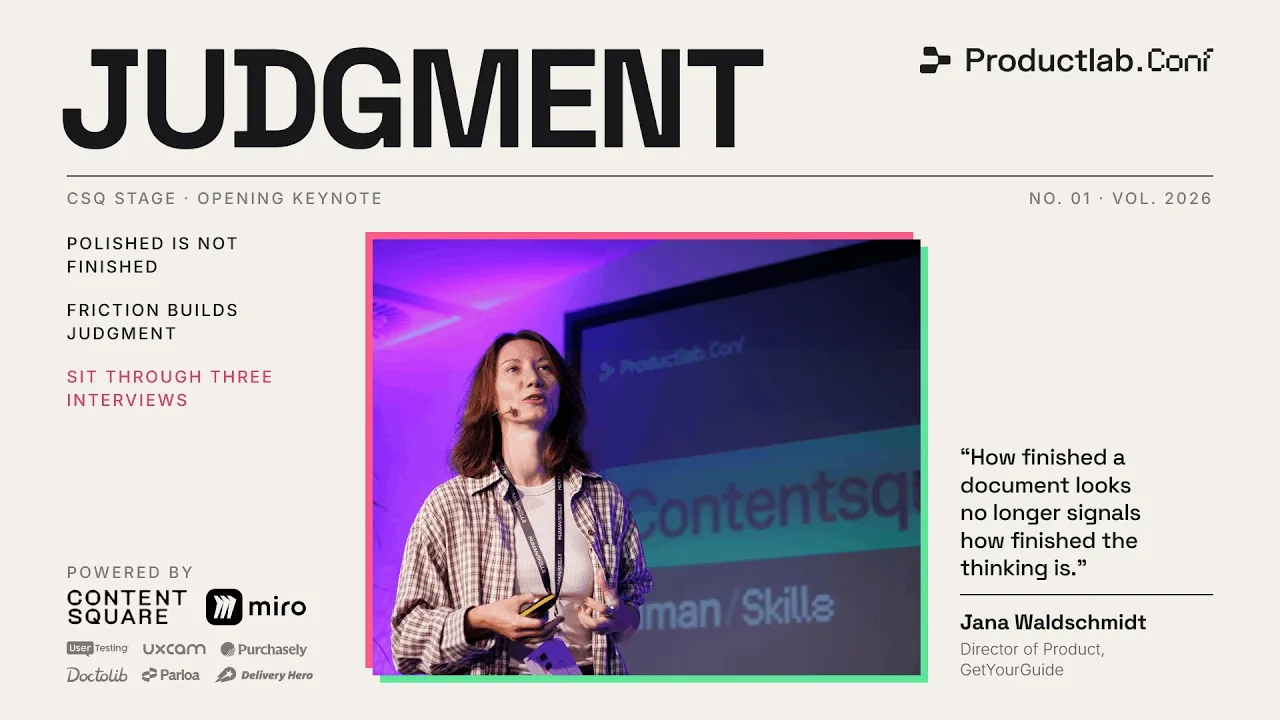
When Everything Looks Finished
Jana Waldschmidt, Director of Product @ GetYourGuide
AI makes strategy docs and take-homes look finished when the thinking isn’t. Jana defines judgment through three behaviours you can observe, and argues it is earned through friction and customer contact.
“The document looked great, but the thinking behind it hadn’t happened.”
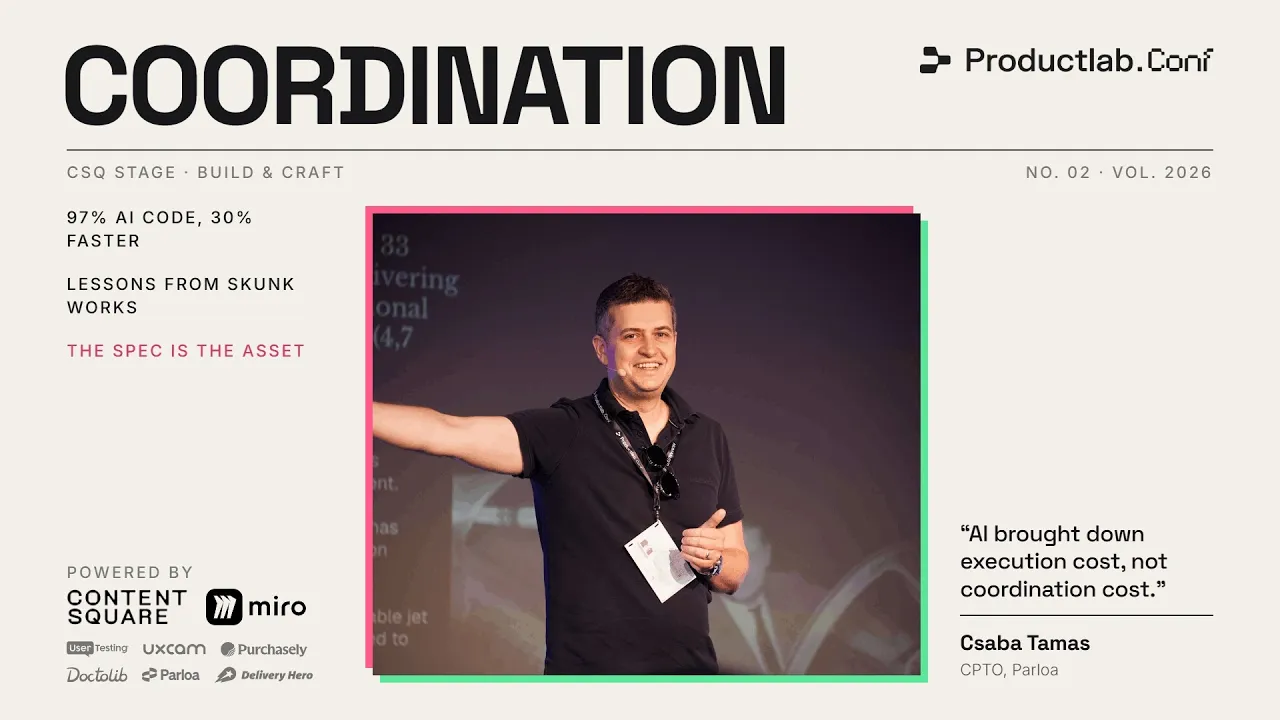
Execution Is Cheap. What now? How to think of AI native companies
Csaba Tamas, CPTO @ Parloa
97% of Parloa’s code changes are built by AI, yet the company is only marginally faster. Using Skunk Works, Csaba argues the bottleneck is decisions and coordination, and proposes a spec-first workflow and metrics for return on AI spend.
“AI just helps us build the wrong product in the wrong way faster.”
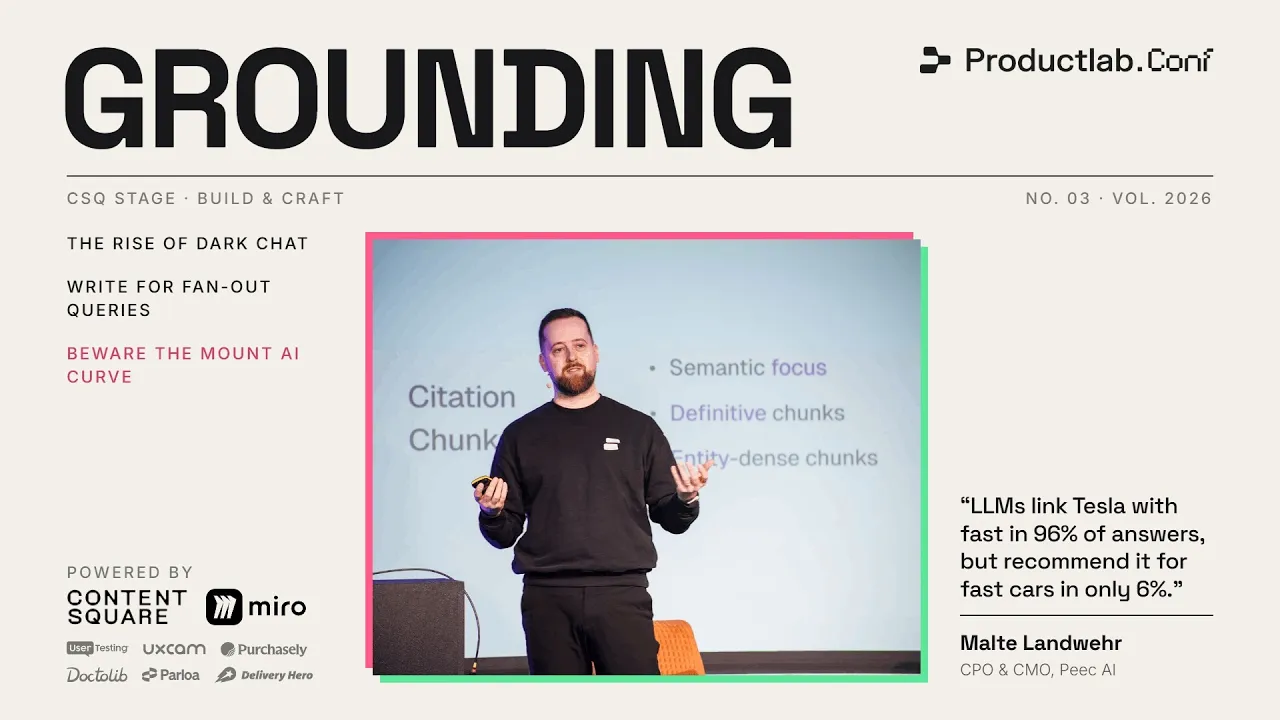
How to make LLMs love your product
Malte Landwehr, CPO & CMO @ Peec AI
How ChatGPT and friends decide which brands to recommend, why your analytics can’t see it (“dark chat”), and which tactics work now.
“So this shows that SEO is in many cases the foundation, but also that very tiny, very stupid mistakes and tweaks can change a lot.”
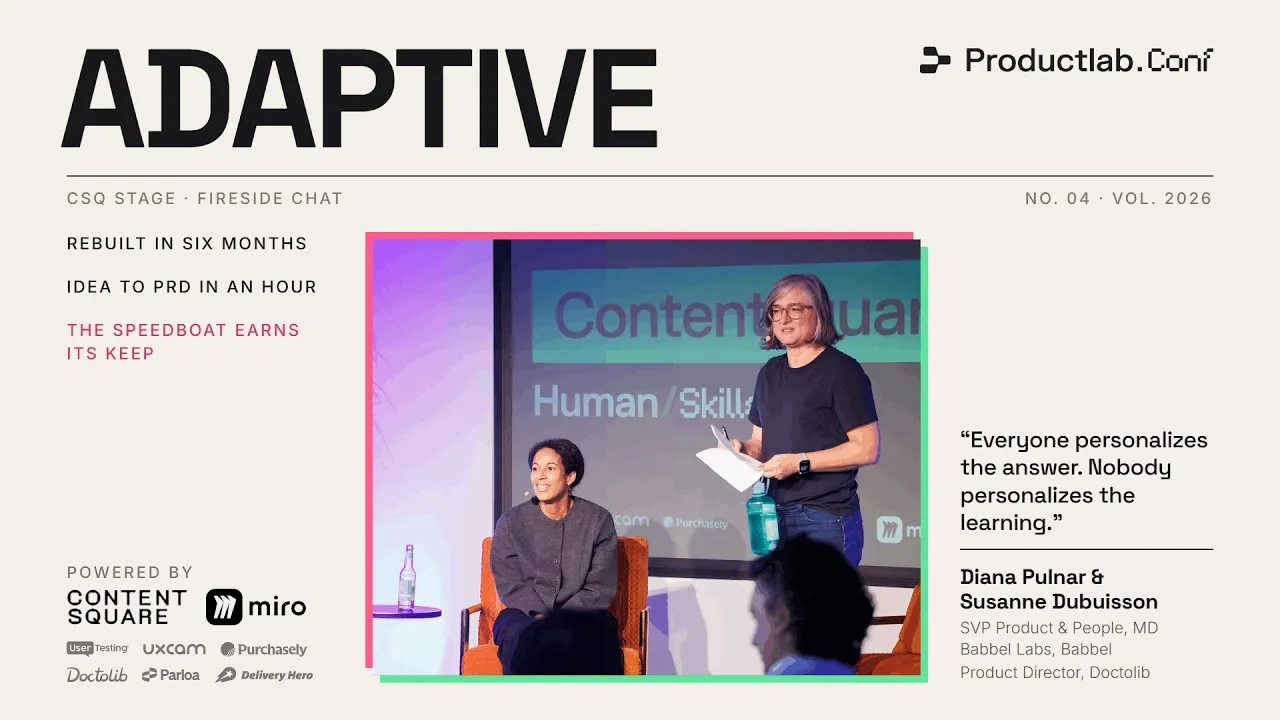
Everyone Personalizes the Answer. Nobody Personalizes the Learning.
Diana Pulnar, SVP Product & People, MD Babbel Labs @ Babbel, with Susanne Dubuisson, Product Director @ Doctolib
Language learning became a commodity overnight. A small team with one leader rebuilt Babbel for Gen Z in six months, going from PRD to prototype in hours, and found out where the human cost shows up.
“the speed is so high but our mental capacity hasn’t improved.”
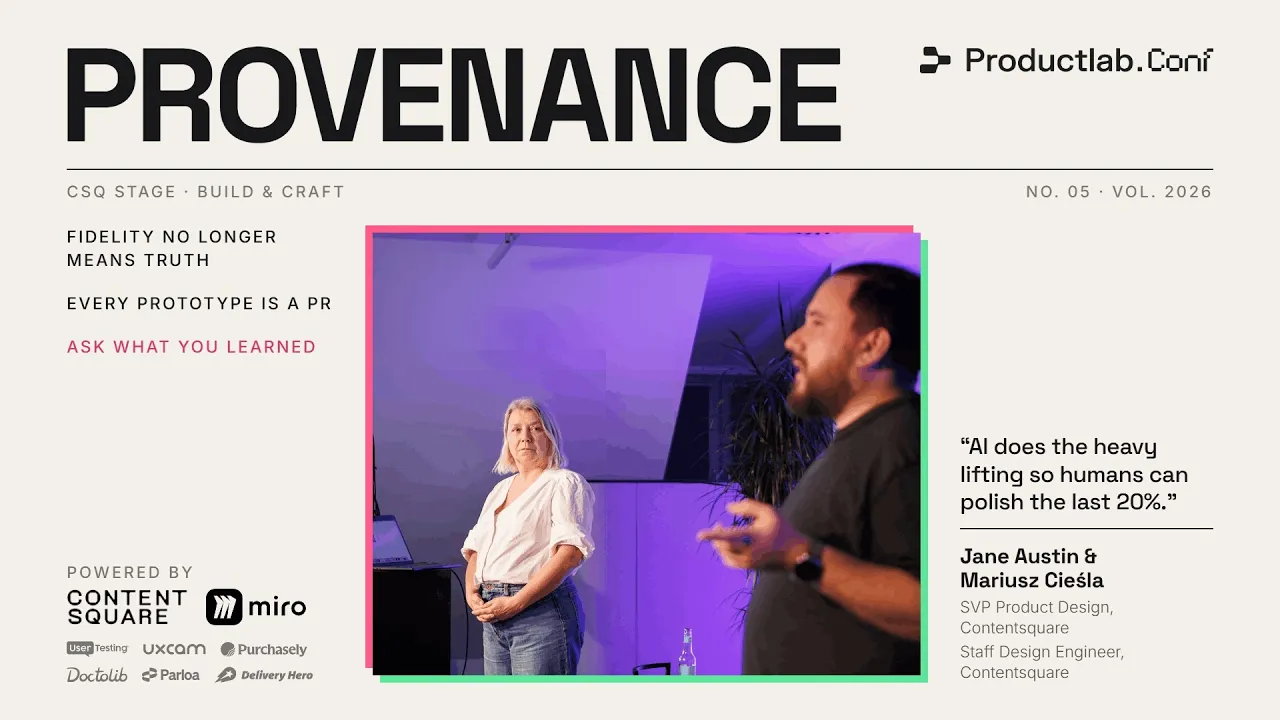
How Contentsquare Ships Product
Jane Austin, SVP Product Design @ Contentsquare, and Mariusz Cieśla, Staff Design Engineer @ Contentsquare
How Contentsquare speeds up delivery with AI prototyping: a searchable “playground” where every prototype carries its provenance, and the culture and context layer AI needs to work.
“AI prototypes can be beautiful and high-fidelity, but not actually true.”
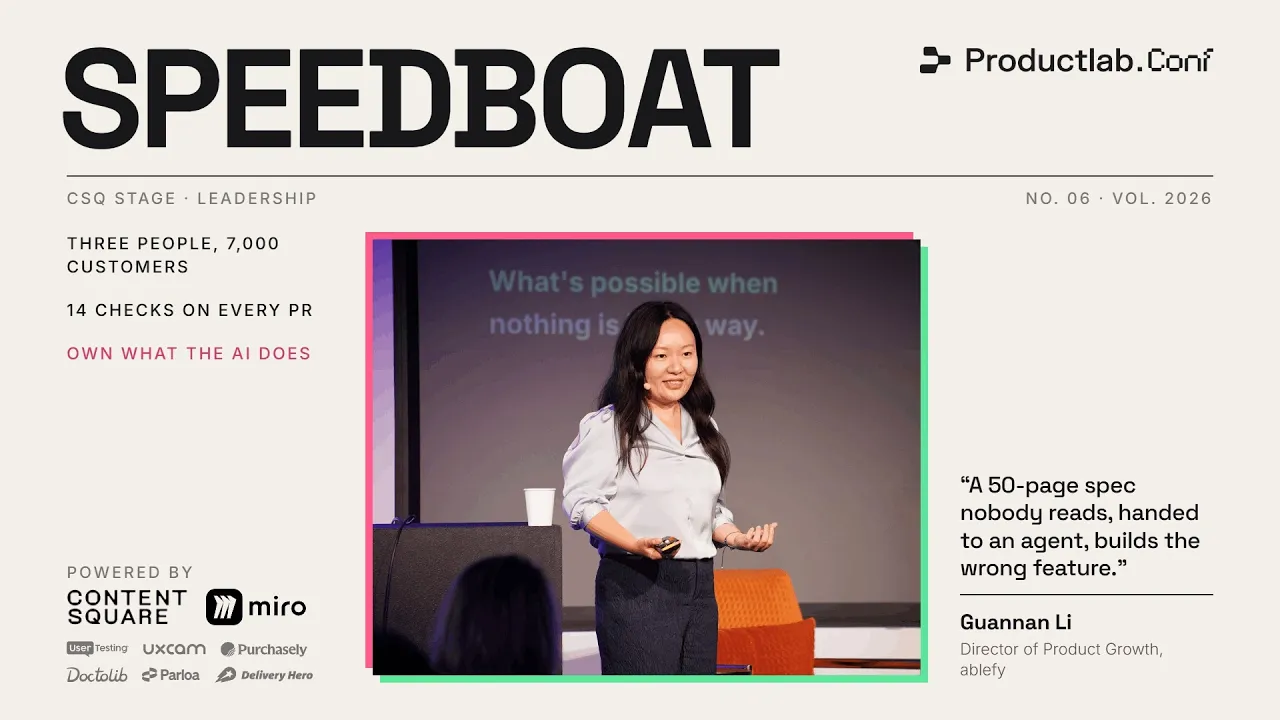
What the AI-Native Playbook Doesn’t Tell You
Guannan Li, Director of Product Growth @ ablefy
Twelve months of a three-person “speedboat” next to a ten-year-old “battleship”: 7,000 active customers, six months of engineering pushback, and the harness that ended the fight.
“AI has to enable humans, not the other way around.”
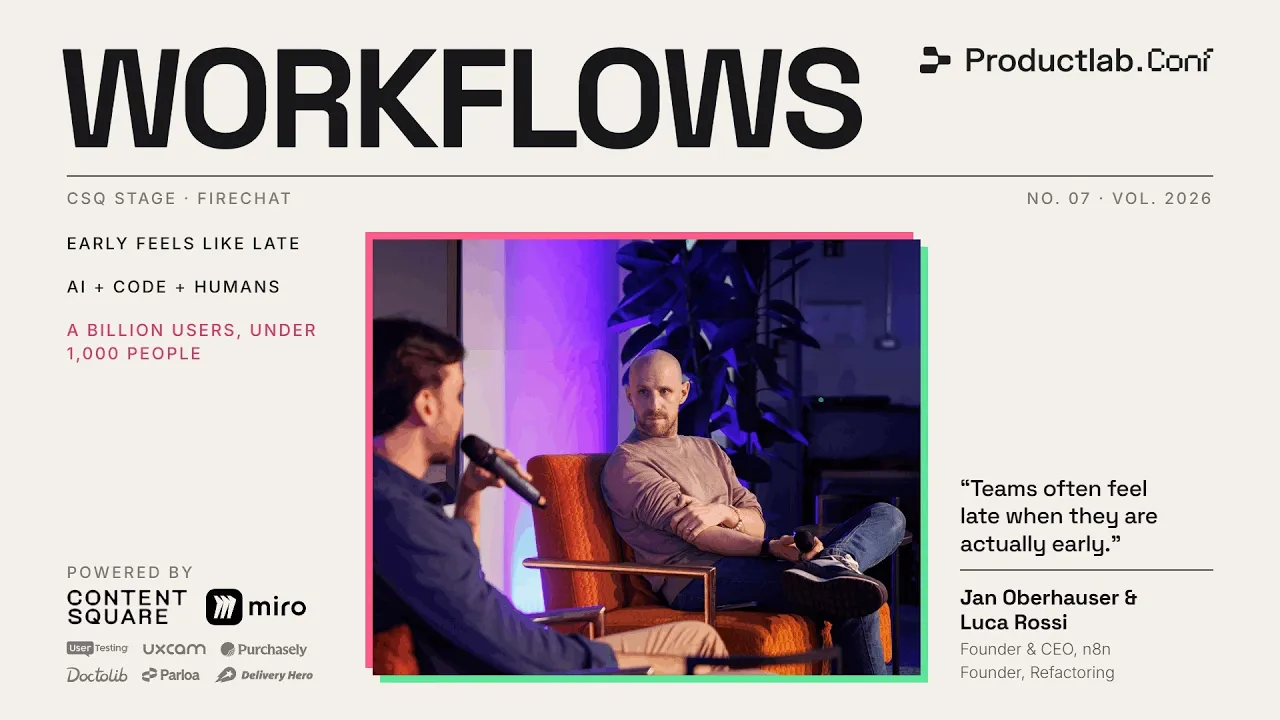
Firechat: The Future of AI Workflows
Jan Oberhauser, Founder & CEO @ n8n, with Luca Rossi, Founder @ Refactoring
Why n8n mixes AI with plain code and humans, why being profitable lets it turn down contracts that would make the product worse, and why it now has two PMs for every six engineers.
“AI is not the solution for literally everything; it’s one part of the solution.”
▶︎ Video
■ Slides
✦ For AI

Against Simplicity
Prasad Gupte, VP, Digital Products @ tonies
Complexity isn’t bad in itself: owned on purpose, it becomes a moat. A simple grid for deciding which complexity to kill, solve, defend or innovate on.
Full talk coming after review
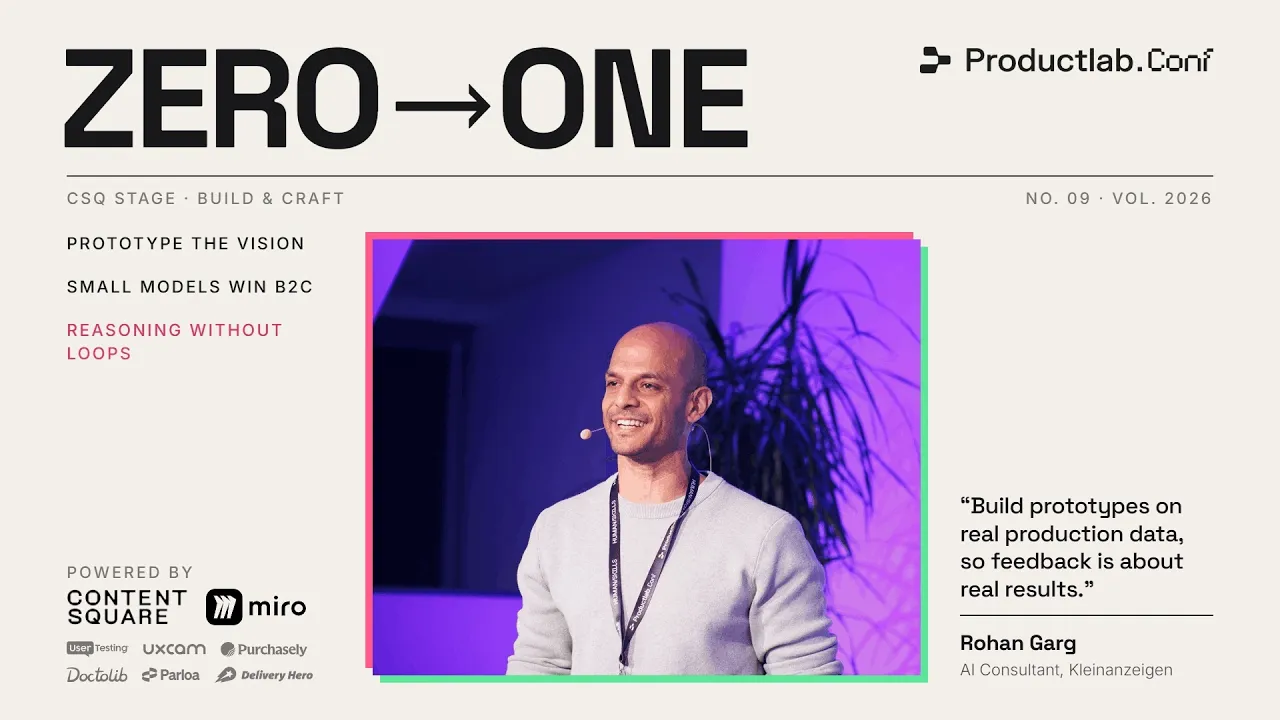
Building 0→1 AI products
Rohan Garg, AI Consultant @ Kleinanzeigen
From investor prototypes to a live shopping assistant: why small models win in B2C, “reasoning without loops”, and what happens when only eight results fit in a chat.
“you prototype the vision and don’t prototype the MVP.”
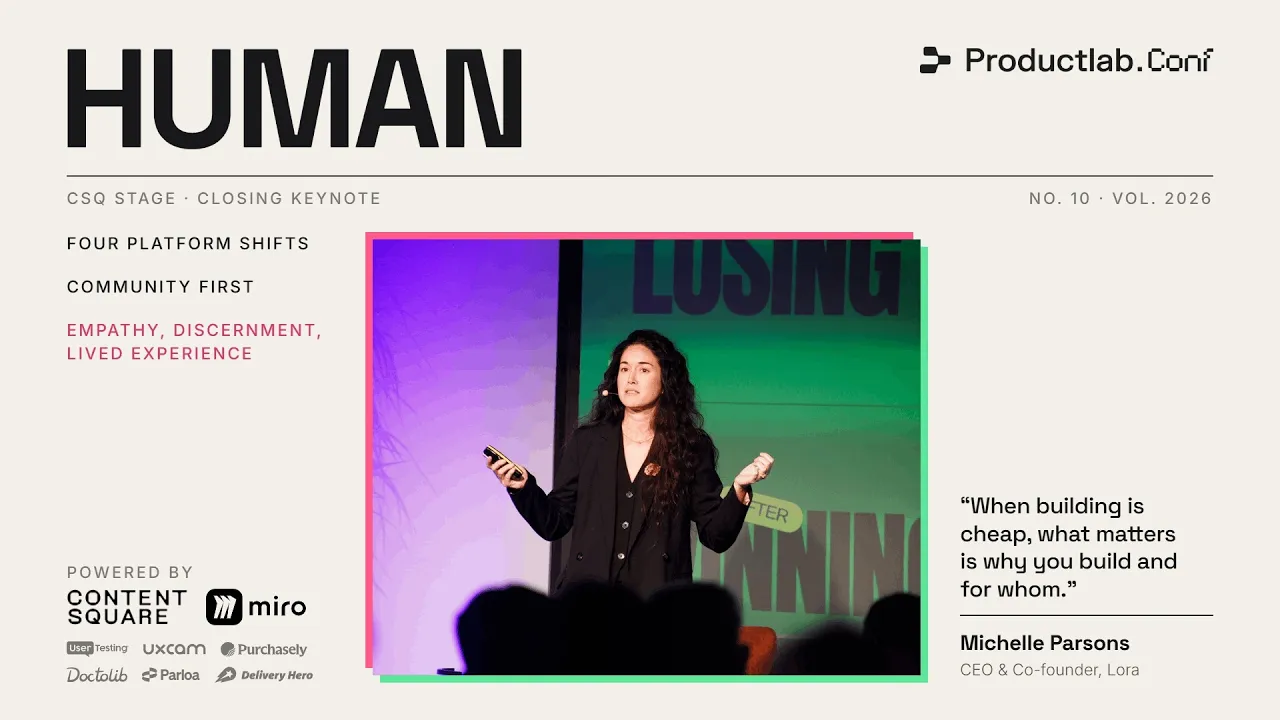
Still Human
Michelle Parsons, CEO & Co-founder @ Lora
After a day of agents, the closing keynote asked what makes product people irreplaceable: empathy, discernment that is really yours, and lived experience. Plus how Lora was built community-first.
“I don’t want my agent talking to my friend’s agent, setting up a meeting at some random restaurant that happens to have availability.”
< Miro Stage >
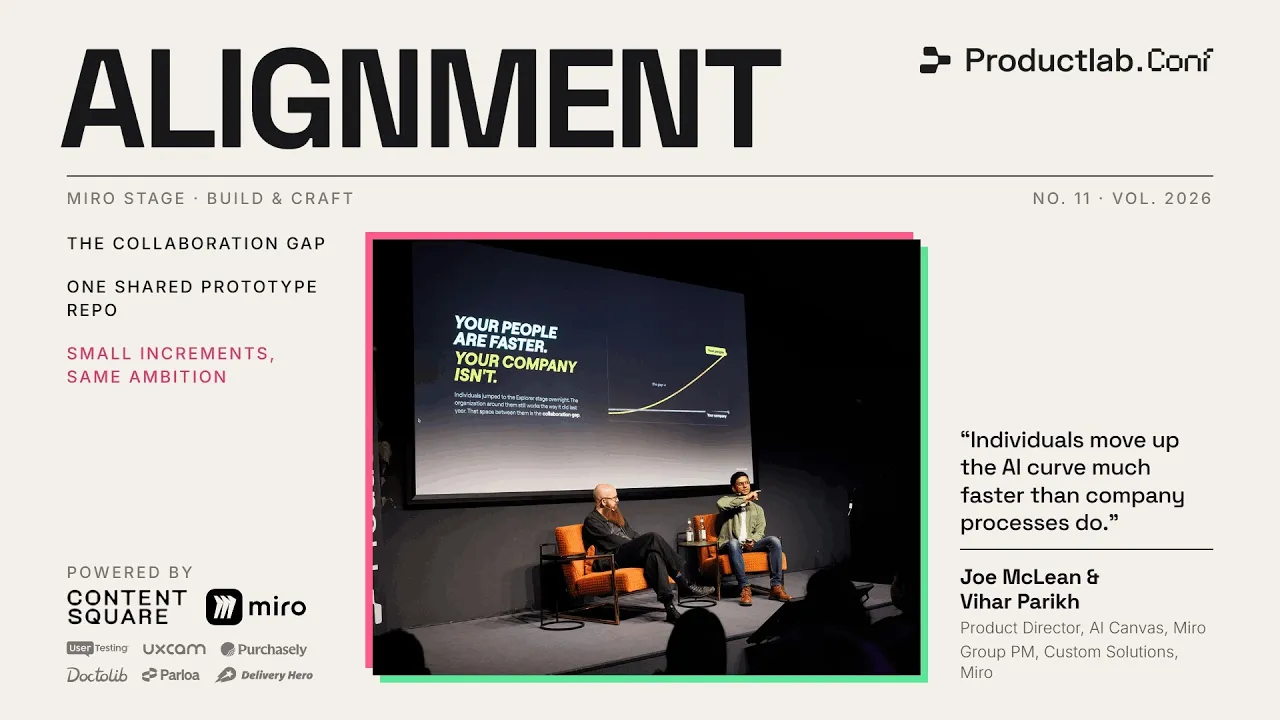
From AI Assisted to AI Native: Rewiring how your teams innovate
Joe McLean, Product Director, AI Canvas @ Miro, and Vihar Parikh, Group Product Manager, Custom Solutions @ Miro
AI speeds up individuals faster than organisations can absorb. The “collaboration gap”, the fractures behind it, and how Miro rewired design and prototyping around it.
“Ultimately, your people are faster and your company isn’t.”
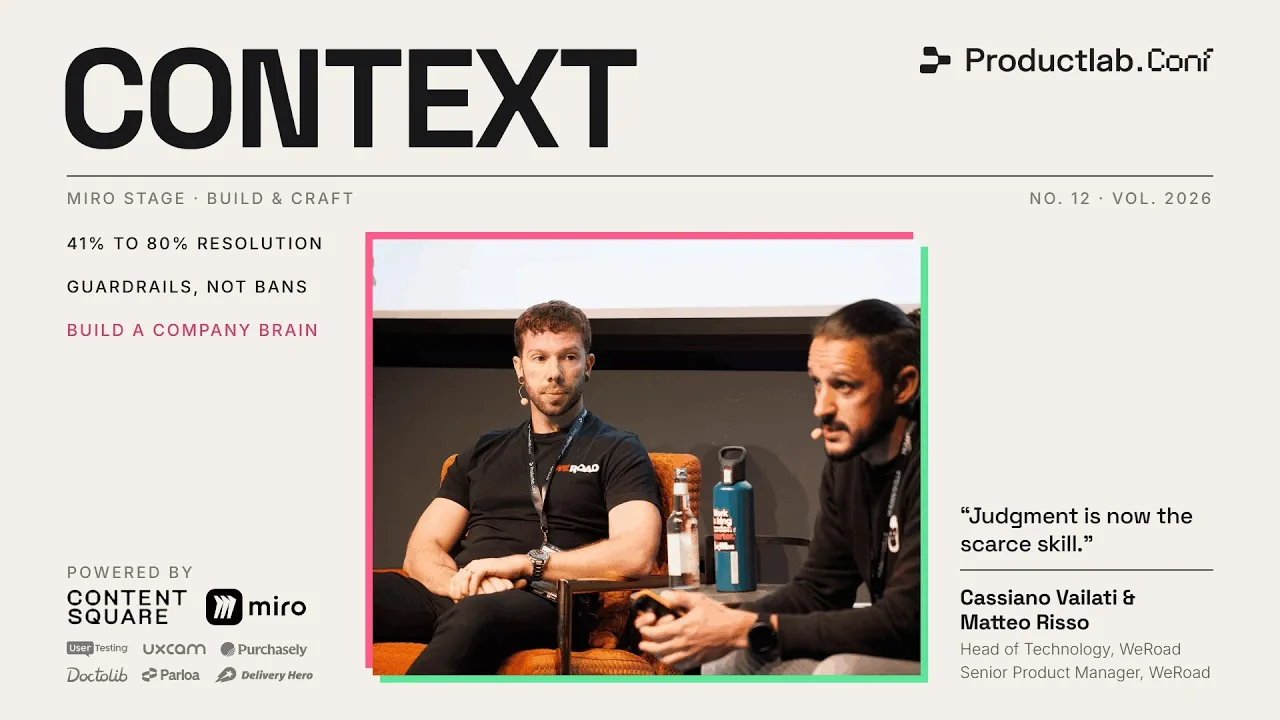
WeRoad: An AI Journey
Cassiano Vailati, Head of Technology @ WeRoad, and Matteo Risso, Senior Product Manager @ WeRoad
Two years of AI at a travel scale-up, with numbers on each track: chatbot, engineering, company-wide rollout, company brain and automation. Then a PM on how his job changed.
“the most important thing is to use your judgment to decide what really needs to be done, and to avoid misjudging at scale.”
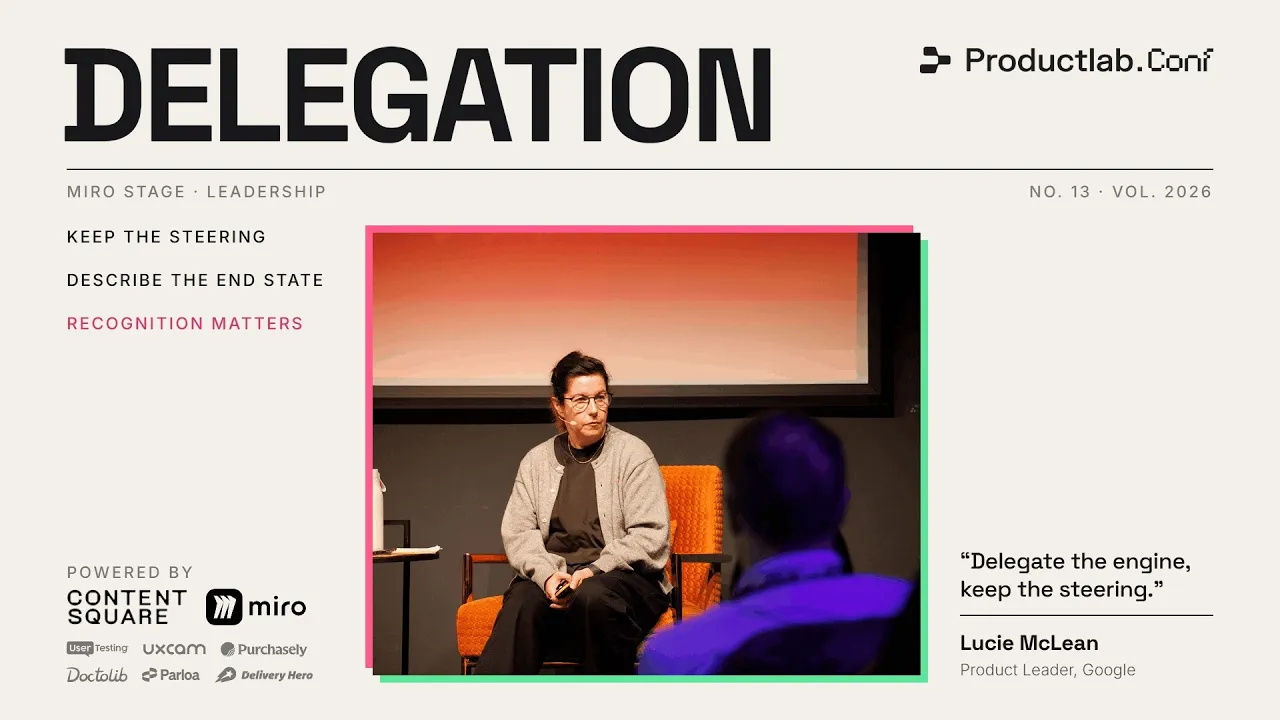
Stop micromanaging, start scaling
Lucie McLean, Product Leader @ Google
A working session on why leaders don’t delegate: four mindsets that get in the way, and tools for each, with context as the leader’s main tool.
“your job is to keep the steering but delegate the engine.”
No audience Q&A in video or transcript
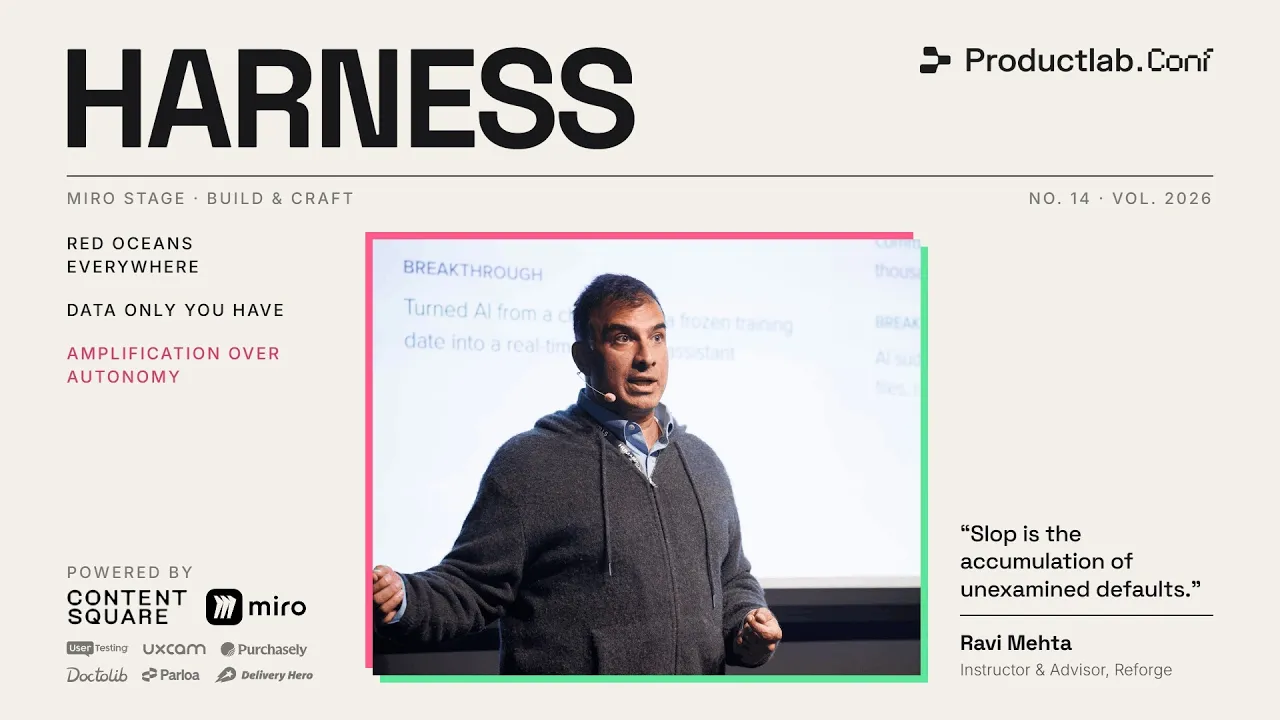
Building AI Products Competitors Can’t Match
Ravi Mehta, Instructor & Advisor @ Reforge
Everyone has the same models. Ravi’s Lego-block framework shows how your data and functionality make AI features no one can copy, with Granola as the case study.
“The slop today is prettier than the slop from yesterday, but it’s still slop.”
< Doctolib Stage >

The Interface Is Not Your Product. Now What?
Dajana Aleksic, Head of Product & CX @ Mercedes-Benz
When interfaces get simpler, complexity doesn’t disappear, it moves: in her case into ownership across teams and the customer journey. A diagnosis-first approach to strategy: gather signals, ask why, and name the challenge in one sentence.
Not filmed · No transcript · Summary only

From Feature Factory to Economic Ownership
Florian Bonnet, VP Product Solutions & Growth @ Veriff
Shipping velocity doesn’t track revenue. Florian’s five-pillar “economic architecture” turns product from a feature factory into an economic system. The room overflowed.
“But if everybody ships fast because AI is accessible to everybody, is that really the new moat? Maybe not.”
Not filmed · Full transcript available

For product builders: Let(‘s) build.
Vito Bica, Founder & CPTO @ Arcate
Twenty years of building across hardware, clinical software and AI. Being a product builder is a decision chain and an operating scope, not a job title.
“But it’s not a tool that will make you a product builder; it’s the way you think.”
Not filmed · Full transcript available

Start the Hard Talk
Alexandru Bleau, Senior Innovation Manager @ E.ON Group Innovation
A LEGO® Serious Play® workshop: people built the conversation they were avoiding, looked at it from the outside, and left with a concrete next step. ---
“There’s something very helpful about making our thinking explicit.”
Not filmed · Full transcript available
< Next conference >
Productlab Conference 2027
7-9 September 2027 · Berlin
Leaders Lab, AI-Craft Day and Conference Day, back in Berlin. Join the waitlist to hear first when tickets open.
< 2025 >
2025: every talk, written up
14 talks from Productlab Conference 2025, plus the recap. What worked, what failed, what to try on Monday.

How Product Managers Survive (and Thrive) When Growth Isn't Enough Anymore
How to survive as a PM when your company shifts from growth to profitability.
Bandan Singh
·
riverty

How to Build Product Teams That Actually Care (And Keep Them That Way)
What 12 years of building teams at Zalando, On, and GS taught Vivek Juneja about creating outcome-driven organizations
Vivek Juneja
·
Consultant

How WeRoad Turned 1,200 Solo Travelers Into a Year-Round Community Movement
WeRoad had thousands of travelers who loved their trips. The problem? They only traveled twice a year.
Simone Basso
·
WeRoad

Why Most Companies Are Asking the Wrong Questions About AI
The Four Strategic Frameworks That Stop You From Building AI Features Nobody Uses.
Elena Leonova
·
Spryker

Escaping the Paid Growth Trap: How Product-Led Growth Beats Paid Ads 10:1
The growth strategy that gets stronger as marketing costs rise
Asya Kuznetsova
·
Kraken
AI agents are coming for your business model
Dr. Hayder Schneider's framework for moving from AI theater to P&L impact—before agents eat your business model
Hayder Schneider
·
Aleph Alpha

How SumUp saved 1,700 engineering hours by promoting a customer support agent
A counterintuitive move that turned chaos into clarity. Liza Mello on the hire that gave SumUp's product team its focus back.
Liza Mello
·
SumUp

How to build un-AI-able skills (and why "I don't know" is your superpower)
The closing keynote everyone needed to hear at Productlab Conf 2025
Francesca Cortesi
·
Vend

When 90% of AI Agents Fail: What Zendesk’s Team Learned Building the Real Thing
Based on a talk by Mirza Beširović at Productlab Conf 2025
Mirza Besirovic
·
Zendesk

How HelloFresh and UXCam moved from AI productivity hacks to systemic transformation
The hidden playbook for turning 40% efficiency gains into organization-wide AI capability
Silvanus Alt
·
UXCam

Why 97% of companies fail at product transformation
The brutal truth about going from project to product—and the 4-part framework that actually works
Chris Compston
·
Consultant

How to build AI products that don't get killed by OpenAI
What going from 100K to 1M users in 6 months taught Rows.com about building products that improve every day + Slide to Download
Henrique Cruz
·
Rows

From 12 Months to 3 Months: How Booking.com Cracked the Code on AI Experimentation
The Behind-the-Scenes from Productlab Conf Berlin
Pranav Pathak
·
Booking.com

Stop Building Better Hammers. Start Building Carpenters.
What Stefan Ostwald taught 250 product managers about the AI revolution happening right now.
Stefan Ostwald
·
Parloa

Productlab 2025 Conference Redux
Dave Feldman attended the first Productlab Conf in Berlin and wrote the recap that did not fit on LinkedIn: every talk, and what stuck.
Dave Feldman
·
Freelancer
" height="23px" id="E3vXMlFqc" transform="translate(3 1)" width="8.9412px"/><path d="M 9.5 11.5 L 19 5.75 L 9.5 0 L 0 5.75 Z" fill="rgba(255, 255, 255, 0.65)" height="11.5px" id="ubKUIjrpD" transform="translate(3 12.5)" width="19px"/></svg>)
" height="20px" id="eMN6AGLsh" transform="translate(4 2)" width="17px"/></g></svg>)
